
The State of Origin arena is universally recognized not merely as a rugby league fixture, but as an unforgiving crucible where tactical acumen, physical endurance, and sheer psychological willpower are tested to their absolute limits. As the current series hurtles toward its climactic Game 3 decider, the atmosphere surrounding the Queensland Maroons and the New South Wales Blues has transcended typical sporting rivalry, evolving into a tense, high-stakes battle for generational supremacy and state honor.
In this pressurized environment, the words of a head coach carry immense weight, capable of either steadying a squad’s nerves or igniting a firestorm of expectation. Recently, Queensland Maroons head coach Billy Slater delivered a masterclass in the latter, articulating a sentiment that has resonated deeply with the state’s passionate fanbase. With a chillingly calm resolve, Slater declared, “I will do everything to achieve victory.” In the modern era of hyper-analyzed sports media, such a statement could easily be misconstrued as arrogant bluster or a desperate plea for momentum.
However, when delivered by a man whose entire career has been defined by an uncompromising pursuit of excellence, this declaration is not a hollow threat; it is a meticulously calculated promise of total commitment, and it has sent a wave of absolute jubilation throughout the Maroons’ loyal supporters.

To fully comprehend the gravity of Slater’s words, one must first analyze the complex landscape of the current series. Game 3 is never just another match; it is the definitive chapter of the year’s narrative, a fixture where legacies are either permanently forged or brutally dismantled. The New South Wales Blues present a formidable challenge, possessing a roster brimming with elite talent and a desperate hunger to reclaim the shield. Yet, the Maroons camp is currently vibrating with an unmistakable, potent energy, a collective morale that has been significantly bolstered by a convergence of highly favorable circumstances.
Slater’s unwavering confidence is not born of blind optimism, but rather from a profound understanding of the pieces he is currently assembling on his tactical chessboard. The foundation of this renewed optimism rests heavily on two critical pillars: the timely return of a defensive titan and the spectacular ascension of a playmaking prodigy.
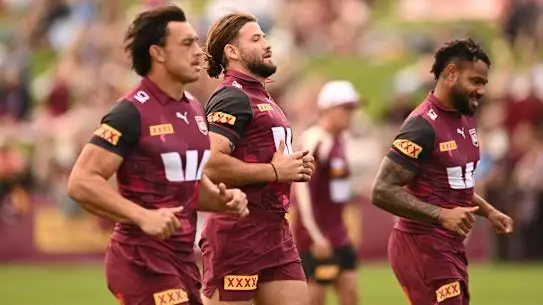
The first, and perhaps most structurally significant, piece of good news for the Maroons is the highly anticipated return of Patrick Carrigan to the forward pack. In the brutal, attritional warfare of State of Origin, the middle third of the field is where games are unequivocally won or lost. It is a zone of relentless physical confrontation, where momentum is generated through agonizingly hard-fought yards and suffocating defensive pressure. Carrigan is the undisputed engine of the Queensland forward rotation.
His absence in previous encounters forced the Maroons to reshuffle their defensive structures and placed an immense, often unsustainable workload on the remaining forwards. Carrigan’s return reinstates a level of physical dominance and defensive reliability that is virtually unparalleled in the modern game. His capacity to absorb offensive pressure, stall the opposition’s momentum in the tackle, and generate lightning-fast play-the-balls provides the Maroons with the exact platform required to dictate the tempo of the match.
Furthermore, Carrigan brings an intangible quality of leadership; his mere presence on the field elevates the work rate of those around him, instilling a sense of calm resilience in the face of the inevitable Blues’ onslaught.

Complementing this injection of brute force in the middle is the breathtaking peak form of halfback Sam Walker. If Carrigan provides the canvas, Walker is currently wielding the brush with absolute mastery. The young playmaker has silenced all remaining skeptics with a string of performances that have redefined his status from a promising talent to an elite orchestrator. In the Origin arena, where defensive lines rush up with terrifying speed, a halfback’s ability to process information and execute under extreme duress is paramount.
Walker has demonstrated an almost preternatural ability to read the Blues’ defensive structures in real-time, utilizing his exceptional vision to identify microscopic weaknesses. His kicking game, a vital weapon in the territorial battle of Game 3, has been pinpoint, repeatedly pinning the opposition deep in their own half and forcing grueling, energy-sapping exits. More importantly, Walker’s confidence is currently infectious. He is playing with a rare combination of youthful audacity and veteran composure, a dynamic that perfectly complements the structured, high-percentage football traditionally favored by Slater.
The synergy between Carrigan’s foundational grunt work and Walker’s expansive brilliance provides Queensland with a multi-dimensional attack that is notoriously difficult to defend against.
It is the confluence of these factors—the return of a premier forward, the zenith of a star playmaker, and a squad galvanized by the stakes of a decider—that forms the backdrop of Billy Slater’s resolute declaration. The Maroons are not merely preparing for a game; they are mobilizing for a definitive athletic conflict. The team’s morale is reportedly at an all-time high, characterized by a laser-like focus and an unbreakable internal bond. This is the fabled “Queensland spirit” weaponized for the modern era.
However, the most compelling aspect of the lead-up to Game 3 has not just been Slater’s promise of maximum effort, but his surprising revelation regarding the specific methodology he intends to employ to dismantle the Blues. Fans and analysts alike were anticipating a discussion of complex, sweeping offensive structures or trick plays designed to catch the opposition off guard.
Instead, Slater stunned observers by pivoting in the exact opposite direction, revealing that the Maroons’ path to victory in this honor match will not be paved with flashy highlight-reel moments, but rather through an absolute, fanatical domination of the game’s most grueling, unglamorous micro-battles.
Slater elaborated that “doing everything to achieve victory” translates to a militant commitment to the one-percent effort areas. He detailed a tactical blueprint built entirely around off-the-ball work: suffocating kick-chase pressure, hyper-aggressive marker defense, winning the physical wrestle in the ruck, and executing flawless, unified defensive line speed. By stripping the game plan down to these foundational elements, Slater is essentially challenging his team to out-work, out-endure, and out-suffer the New South Wales Blues. This is a profound psychological masterstroke.
Rather than burdening his players with the anxiety of executing perfect, complex offensive maneuvers in the most high-pressure environment imaginable, he has shifted the focus to effort—a variable that is entirely within their control. He is demanding a level of intensity in the trenches that simply breaks the opposition’s will to compete over the full eighty minutes.
This tactical philosophy aligns perfectly with the historical identity of the Queensland Maroons. They have frequently built their dynasties not necessarily by being the most naturally gifted team on paper, but by being the most resilient, the most cohesive, and the most willing to endure physical hardship for the jersey. Slater, possessing one of the most astute rugby league minds in the history of the sport, understands that in a Game 3 decider, fatigue makes cowards of men.
By focusing the team’s entire mental energy on controlling the ruck speed and defensively suffocating the Blues’ playmakers, he aims to induce that fatigue early and exploit it mercilessly. The combination of Carrigan leading the physical charge in the middle and Walker capitalizing on the resulting chaotic, retreating defensive lines is the precise realization of this strategy.
The reaction from the Maroons’ fanbase to Slater’s revelations has been one of overwhelming adulation and profound relief. In an era where sports rhetoric is often dominated by clichés and empty platitudes, hearing a head coach articulate a clear, logical, and inherently gritty blueprint for victory is intensely reassuring. The fans are not demanding a blowout victory defined by trick plays; they are demanding a performance worthy of the jersey, a performance characterized by total, unwavering commitment. Slater’s assurance that he and his team will “do everything” resonates because it is backed by a tangible, tactical reality.
It is an acknowledgment that the path to Origin glory is brutally difficult, but one that this specific squad, under his meticulous guidance, is entirely prepared to walk.
As the countdown to kickoff accelerates, the anticipation has reached a fever pitch. The narrative is set: a brilliant, uncompromising coach, a roster fortified by returning stars and peaking prodigies, and a tactical plan rooted in the absolute domination of the game’s toughest elements. The New South Wales Blues will undoubtedly arrive with their own desperate ambitions and tactical counter-measures, setting the stage for what promises to be an instant classic in the annals of rugby league history. Billy Slater has drawn the battle lines, defining the terms of engagement with clinical precision.
The Maroons are primed, not just to participate in a football match, but to execute a comprehensive athletic siege. The only remaining question is whether the execution on the night will match the intensity of the preparation.
Considering Billy Slater’s strategy of prioritizing absolute dominance in the unglamorous, high-effort micro-battles—such as ruck control and kick pressure—over complex attacking plays, do you believe this grueling, war-of-attrition approach is the most reliable way to secure victory in a high-pressure State of Origin decider, or does it risk stifling the natural attacking flair of instinctive players like Sam Walker against a highly skilled Blues defensive line?